Monitoring Threats from Space
We educate the public about two critical threats: asteroid impacts and space debris pollution. Through data visualization and interactive tools, we help you understand the risks and support planetary defense initiatives.
Understanding the key differences between asteroid impacts and space debris
Real-time asteroid distance tracking and collision simulation, plus space debris environmental impact analysis
Recent developments in asteroid tracking and space debris management
Common questions about asteroids and space debris
Scientific sources and datasets used in our platform
Asteroids and comets whose orbits bring them close to Earth
Near-Earth Objects (NEOs) are asteroids and comets whose orbits bring them close to Earth. Understanding them helps us protect our planet.
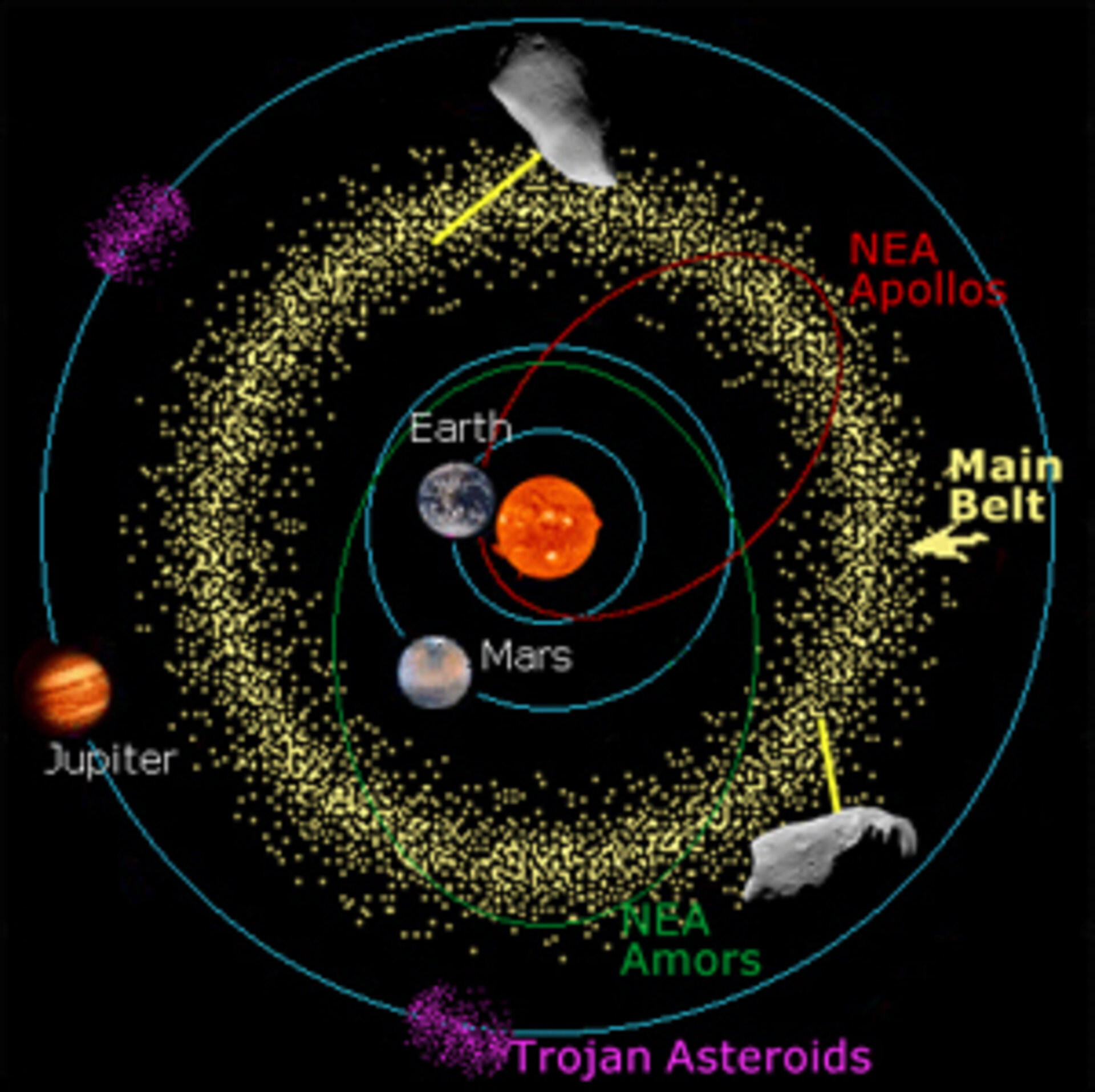
NEOs are cosmic objects whose trajectories bring them within 1.3 astronomical units (AU) of the Sun. This includes objects that cross Earth's orbit. Scientists monitor these objects carefully because even though impact probability is low, the consequences could be catastrophic.
There are over 30,000 known NEOs, with more being discovered regularly. NASA's Planetary Defense Coordination Office tracks these objects and assesses potential threats decades in advance, giving us time to develop mitigation strategies if needed.
Space agencies use ground-based telescopes and space missions to discover and track NEOs.
NEO detection relies on a global network of observatories scanning the night sky. When a new object is discovered, astronomers calculate its orbit to determine if it poses any future threat to Earth. The accuracy of these predictions improves with each observation.
Projects like NASA's NEOWISE mission and the upcoming NEO Surveyor will dramatically improve our ability to find potentially hazardous asteroids, especially those that approach from the direction of the Sun.
Earth has been struck by asteroids throughout history, with varying consequences.
The most famous impact event occurred 66 million years ago when a 10-kilometer asteroid struck what is now Mexico's Yucatan Peninsula, leading to the extinction of the dinosaurs. More recently, the 1908 Tunguska event in Siberia saw an asteroid explode in the atmosphere, flattening 2,000 square kilometers of forest.
In 2013, a 20-meter meteor exploded over Chelyabinsk, Russia, injuring over 1,000 people from broken glass. These events remind us that asteroid impacts are not just ancient history—they remain an active threat that requires ongoing monitoring and planetary defense capabilities.
Understanding the different types of objects in space and their threat levels
Rocky objects that orbit the Sun, mostly found between Mars and Jupiter.
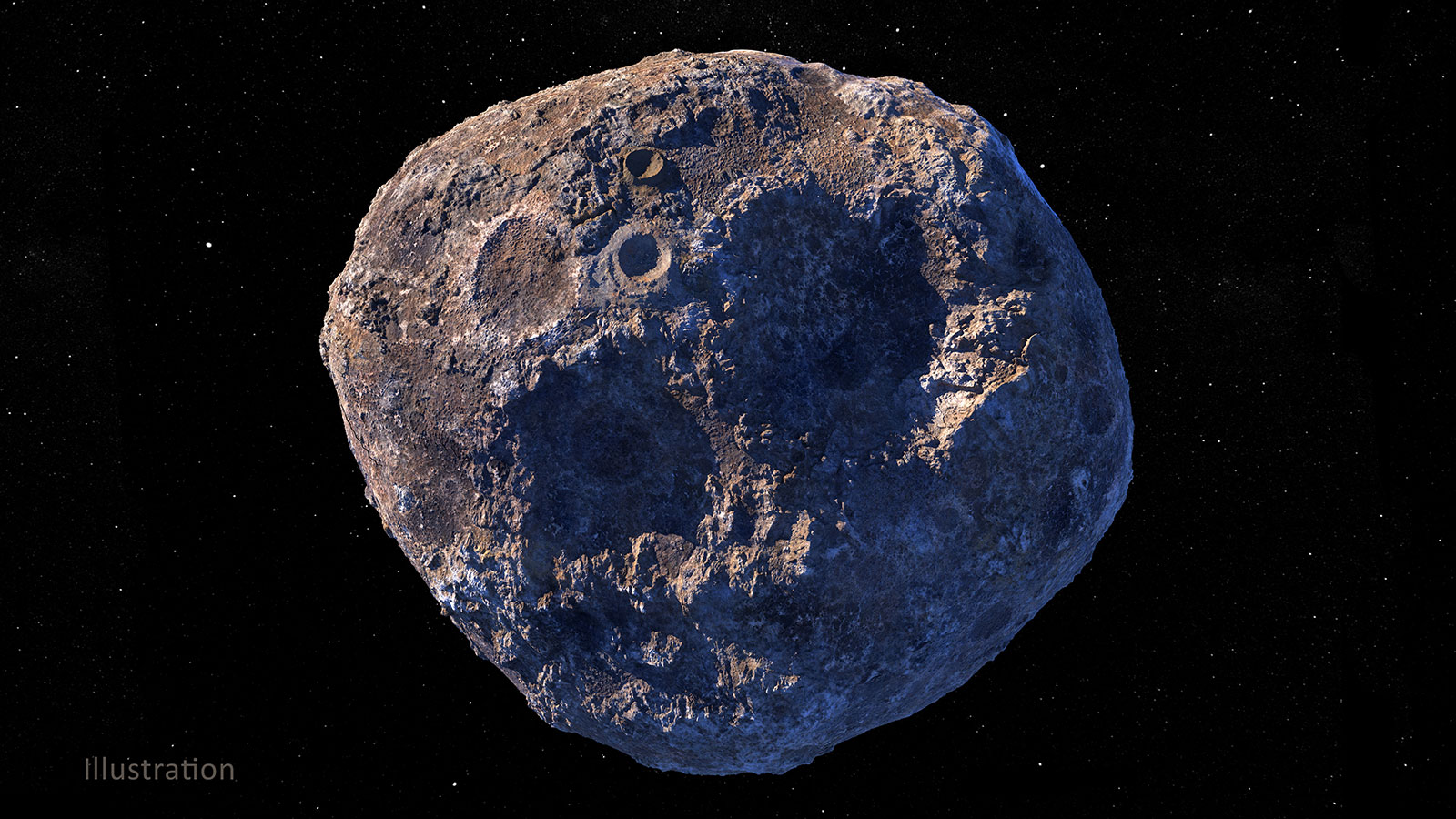
Asteroids are rocky remnants left over from the early formation of our solar system about 4.6 billion years ago. Most asteroids are found in the asteroid belt between Mars and Jupiter. They range in size from small rocks to objects hundreds of kilometers wide. Near-Earth Asteroids (NEAs) have orbits that bring them close to Earth's orbit. Scientists track thousands of these objects to ensure they don't pose a threat to our planet.
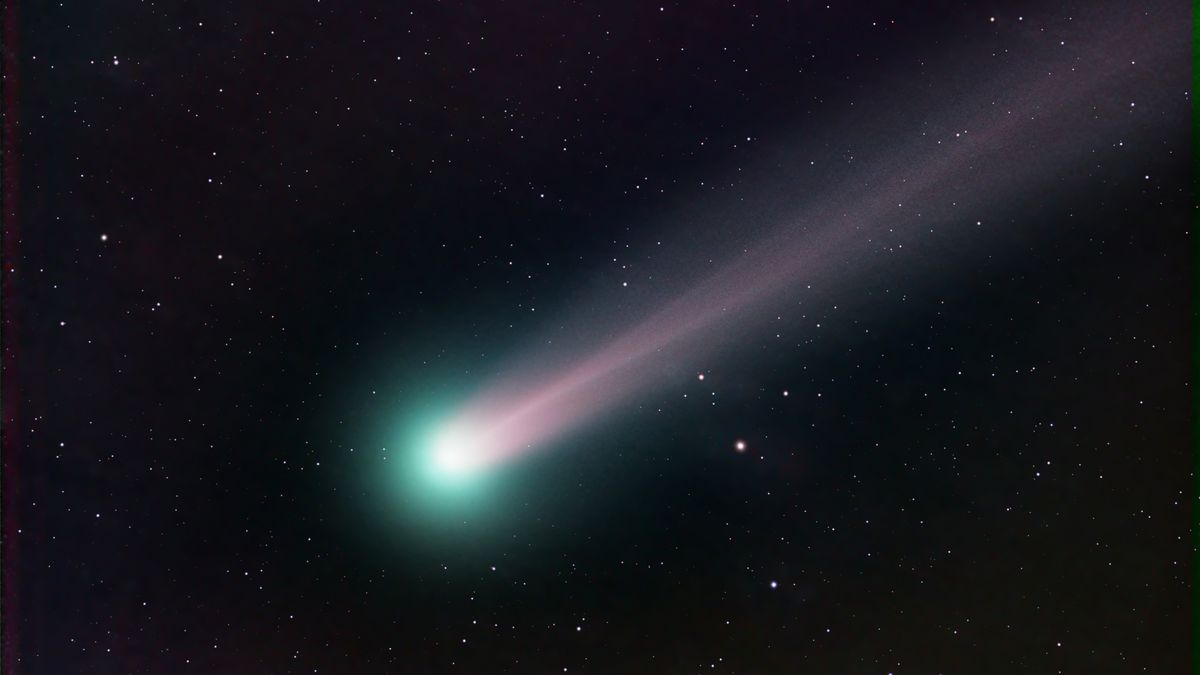
Icy objects that develop tails when approaching the Sun.
Comets are cosmic snowballs made of frozen gases, rock, and dust. When a comet's orbit brings it close to the Sun, it heats up and releases gases, creating a glowing head (coma) and often two tails - one made of dust and one of ionized gas. Some comets take less than 200 years to orbit the Sun (short-period comets), while others take thousands of years. Famous examples include Halley's Comet, which returns every 76 years.
The bright streak of light when space debris burns in Earth's atmosphere.
A meteor is the bright streak of light we see in the night sky, often called a "shooting star." This happens when a small piece of space debris (called a meteoroid) enters Earth's atmosphere at high speed and burns up due to friction with air molecules. Most meteors are caused by particles no bigger than a grain of sand. During meteor showers, Earth passes through debris trails left by comets, creating dozens of meteors per hour.
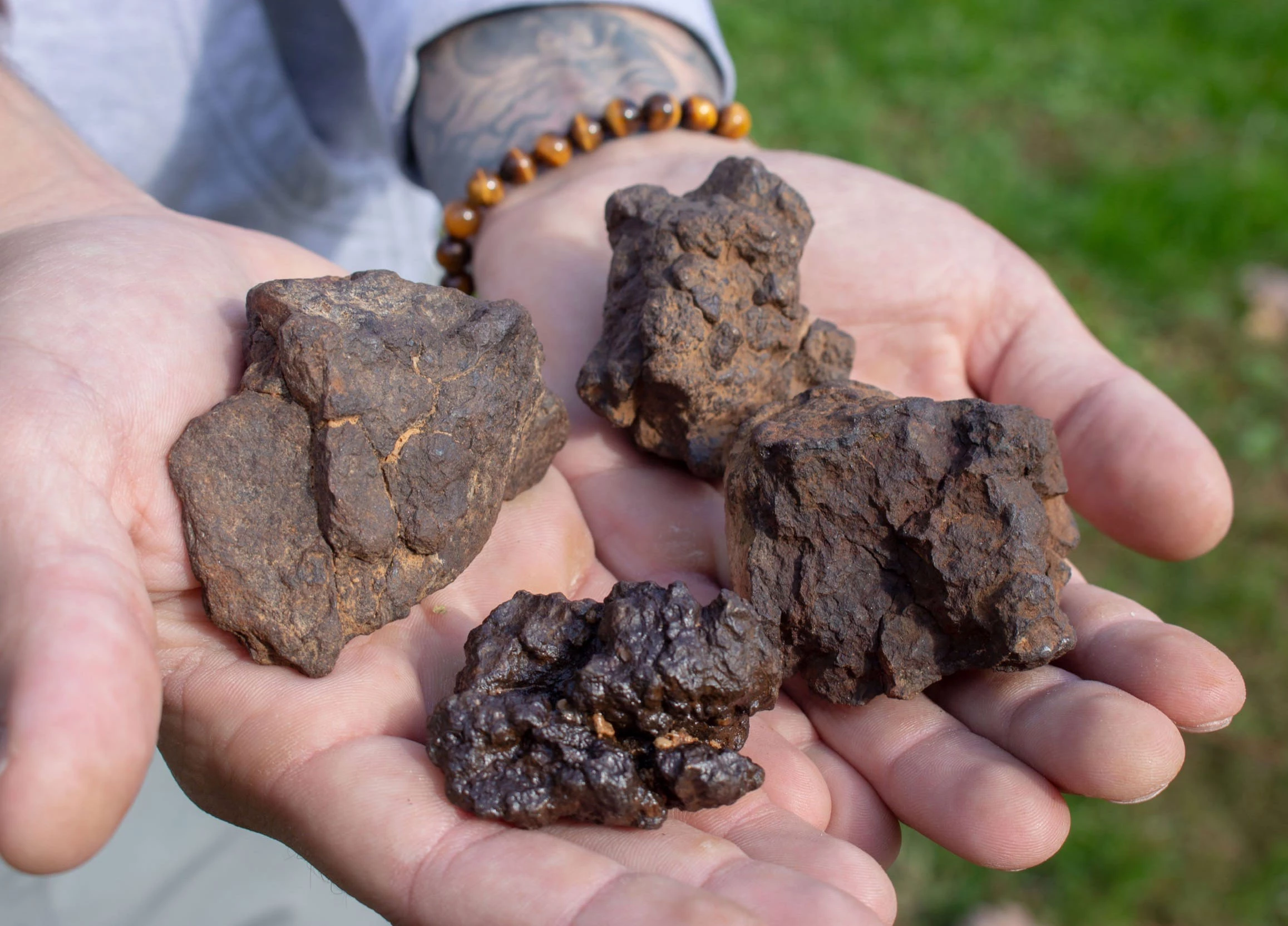
Space rock that survives the journey through the atmosphere and lands on Earth.
A meteorite is a piece of space rock that successfully makes it through Earth's atmosphere and lands on the surface. Most meteorites come from asteroids, though some come from the Moon or Mars. They provide valuable scientific information about the early solar system. Meteorites are classified into three main types: stony (made of silicate minerals), iron (made of metallic iron and nickel), and stony-iron (a mixture of both).
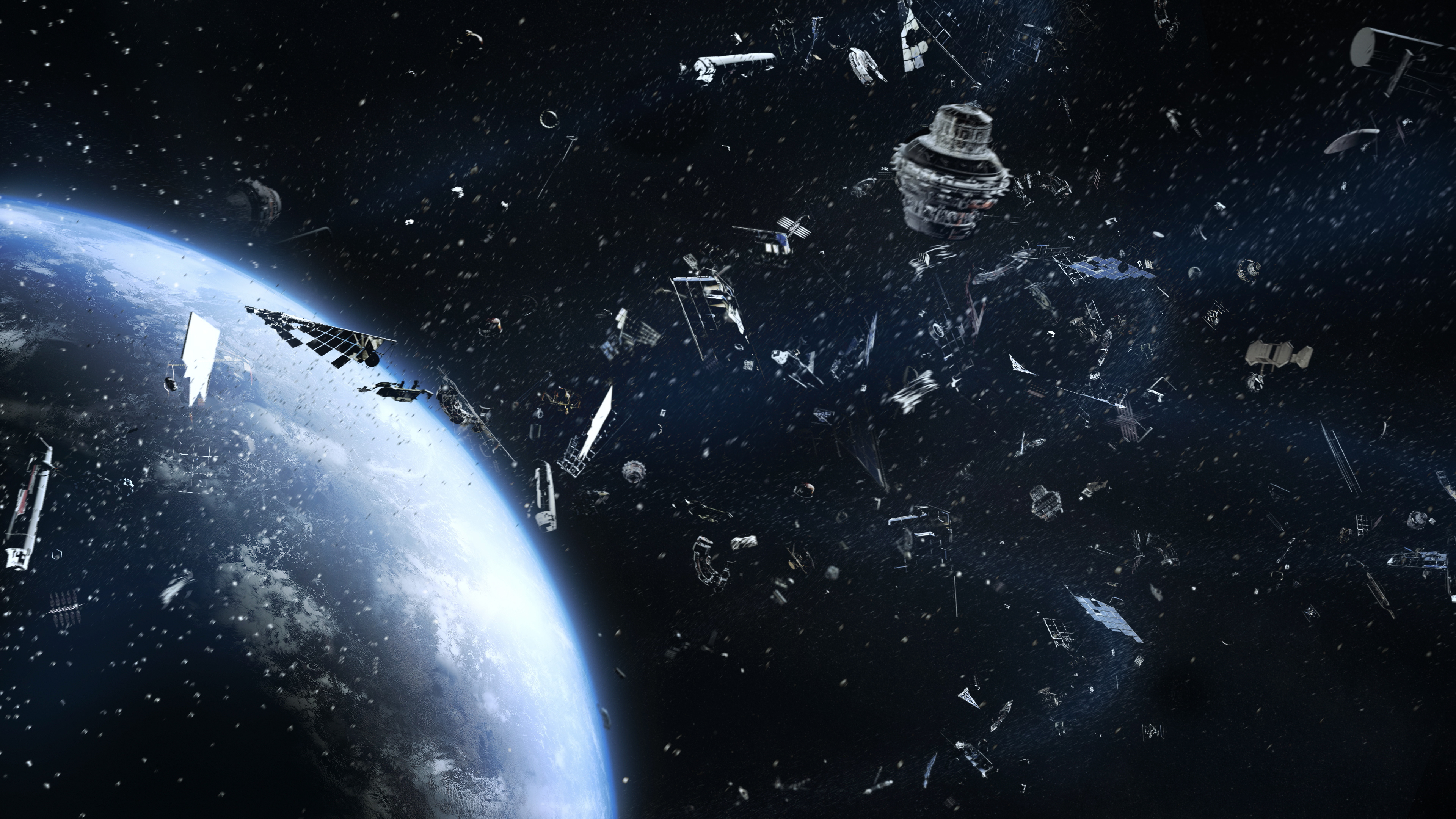
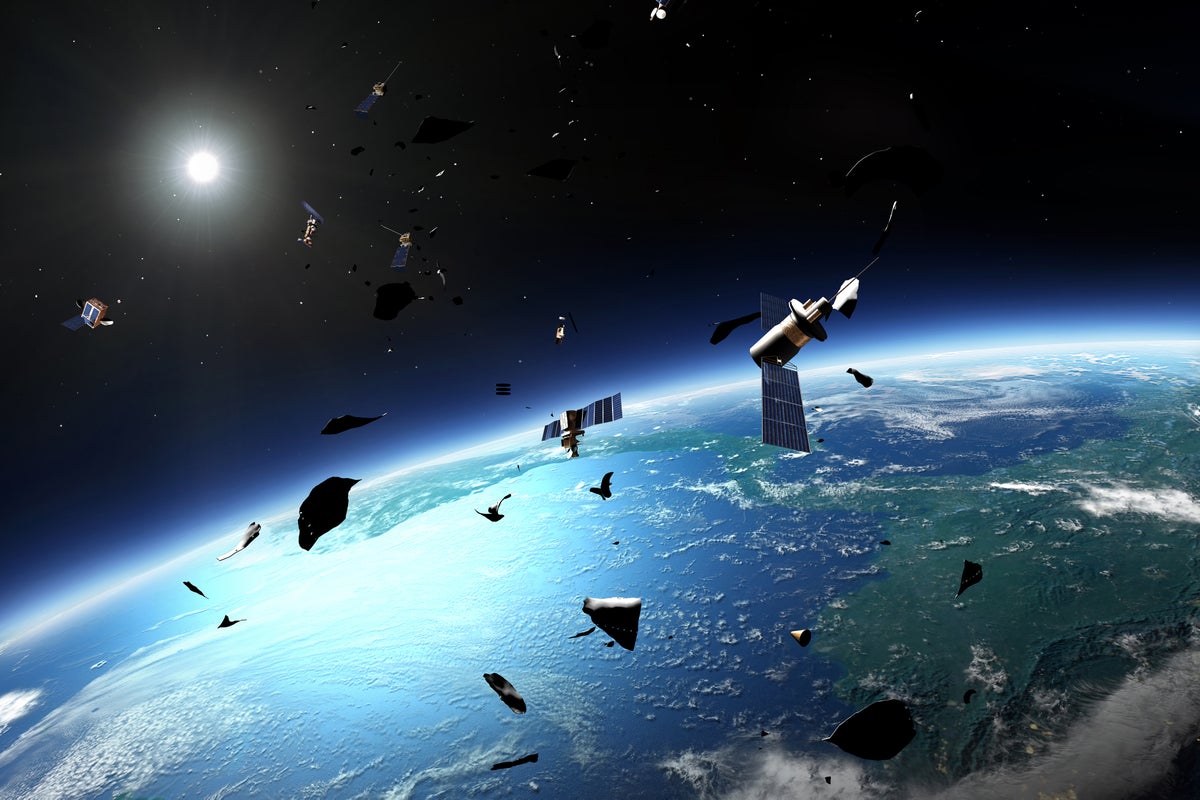
Orbital debris, or space junk, is a growing problem caused by increasing human activity in space, particularly satellite launches and space exploration.
OD arises from launch artifacts, decommissioned satellites, and spacecraft breakups. More debris is created by the Kessler syndrome, which is the collisions between orbiting satellites and existing debris. This situation is exacerbated by the absence of global consensus and regulation, and overexploitation of space. The World Economic Forum estimates that orbital debris currently exceeds 6.3 million kilograms, with projections indicating up to 60,000 satellites at risk of contributing to this problem by 2030.
Human made OD is made up of weather observation & imaging satellites, communication satellite constellations and networks (such as Starlink and Iridium), and space exploration missions such as the International Space Station.
The launch traffic to LEO, which poses 96% the debris reentry problem, is estimated to have more than tripled in the last decade, with approximately 80% of the active payloads inhabiting LEO. The scale of the debris reentry problem implies increased threats to inhabited areas, installations, and infrastructure.
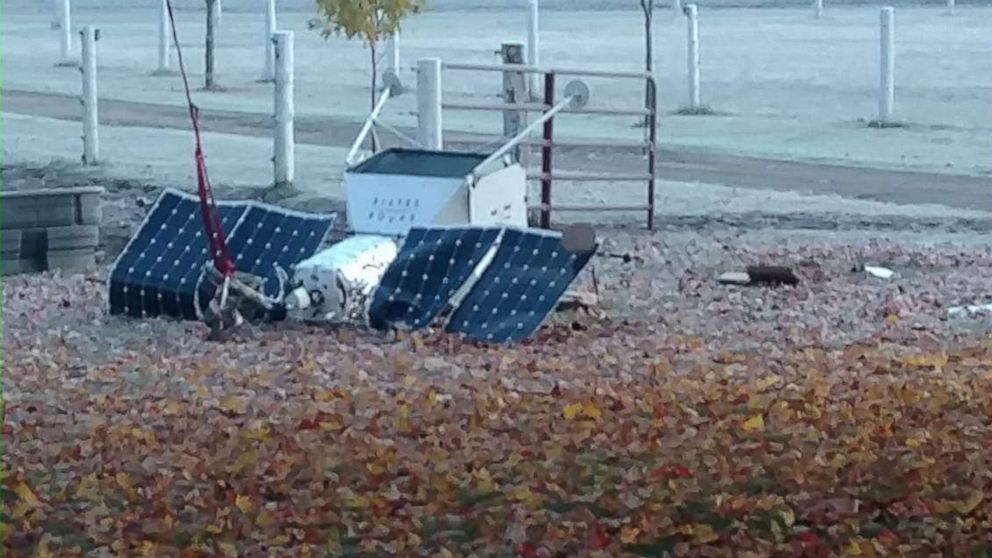
A further hazard is the potential for catastrophic mid-air collisions between a reentering object and an airborne aircraft. This is a real possibility given the amount of air traffic at any given time around the Earth. Uncertainty in predicting the location of space debris reentry is often high due to the complex and variable conditions during descent.
Falling satellites pose risks including atmospheric pollution, ozone damage from metallic particles, potential ground impact from large debris, and the risk of toxic chemicals from fuel sources.
Ozone Depletion: Satellites release aluminum oxides and other metallic particles as they disintegrate, which can reach the stratosphere and contribute to the depletion of the ozone layer.
Atmospheric Heat Balance: These particles can also alter the balance of heat in the atmosphere, potentially having complex effects on Earth's temperature.
Hazardous Materials: Some satellites carry hazardous fuels or radioactive materials, posing a significant risk of poisoning or harming people if these chemicals are released in inhabited areas.
Physical Damage: While rare, large sections of satellites can survive re-entry and strike the Earth's surface with significant force, potentially causing damage to property or infrastructure.
Uncontrolled Re-entry: Many re-entries are uncontrolled, leading to debris being scattered over large areas. While most debris lands in oceans, there's a small but growing chance that larger pieces could impact populated areas.
Increasing Frequency: The number of satellites in orbit is rapidly increasing, leading to a greater probability of re-entry incidents and escalating these environmental and safety concerns.
Controlled Re-entries: To mitigate risks, space agencies are promoting controlled re-entries where satellites are guided to burn up in a designated area, often over the ocean.
Atmospheric Research: Further research is needed to understand the specific physics of satellite re-entry and its atmospheric impact, informing better satellite design and disposal strategies.
The overall risk to an individual from falling space debris is extremely small. However, the long-term environmental consequences, especially concerning atmospheric pollution from the increasing number of satellite re-entries, require careful management and sustainable practices for the future of space.
Risk = Probability × Hazard
Likelihood of collision is effectively zero, or object is too small to penetrate Earth's atmosphere.
Chance of collision is extremely unlikely, about the same as being struck by lightning.
Close attention by astronomers warranted. Collision is possible but unlikely.
Close encounter with significant threat. Careful monitoring essential.
Collision is certain. Evacuation and disaster planning required.
Object burns up completely in atmosphere with no ground damage.
Could cause localized destruction equivalent to a neighborhood or small town.
Capable of causing widespread destruction across a large metropolitan area.
Could cause unprecedented regional devastation across an entire continent.
Threatens human civilization. Global climate effects and mass casualties.
How we detect and protect Earth from asteroid impacts.
NASA and international space agencies actively track near-Earth objects to identify potential threats decades in advance. Detection methods include ground-based telescopes and space missions like NEOWISE. If a threat is identified, several mitigation strategies exist: kinetic impactor (like NASA's DART mission that successfully redirected an asteroid in 2022), gravity tractor (using a spacecraft's gravity to slowly pull an asteroid off course), and nuclear deflection as a last resort. Early detection is crucial - the earlier we spot a threat, the easier and cheaper it is to deflect.
For more comprehensive information on space safety and planetary defense, visit the ESA Space Safety Programme.
Understanding the dangers of orbital debris and falling satellites
Real-time visualization of satellites and space debris orbiting Earth
Interactive 3D globe showing active satellites, debris, and orbital paths. Click and drag to rotate.
A cascade effect where collisions in orbit create more debris, which causes more collisions, potentially making space unusable.
Named after NASA scientist Donald Kessler who proposed it in 1978, the Kessler Syndrome describes a scenario where the density of objects in low Earth orbit becomes high enough that collisions between objects generate a cascade of more collisions. Each collision creates thousands of smaller debris pieces, increasing the likelihood of further impacts.
This scenario is particularly concerning because it could render certain orbital zones unusable for generations, effectively trapping humanity on Earth by making satellite operations and space launches too dangerous. The syndrome has moved from theoretical concern to practical reality as orbital density increases exponentially.
Analyze satellite reentry environmental effects and atmospheric impact scenarios
Open Environmental Impact ModelExplore our tools to visualize and understand space threats
Real-time asteroid distance tracking and collision simulation. Adjust parameters like size, velocity, composition, and impact angle to see how different asteroids would affect Earth.
Launch Asteroid Impact SimulatorAnalyze satellite reentry environmental effects and atmospheric impact scenarios. Understand how space debris affects our atmosphere and contributes to pollution.
Launch Environmental Impact ModelBuilt using actual NASA datasets and scientific models to provide accurate predictions and realistic scenarios.
Adjust variables and see immediate results. Learn through hands-on experimentation with different parameters.
Perfect for students, educators, and anyone interested in understanding space threats and planetary defense.
Understand the real risks and potential consequences of asteroid impacts and space debris pollution.
Meet the team behind the Impactor-2025 project and join our mission to protect Earth
We are a team of passionate space enthusiasts participating in the NASA Space Apps Challenge 2025. Our goal is to create tools that help people understand and prepare for potential asteroid and falling space debris threats. By combining real NASA data with interactive visualizations, we aim to fulfill our mitigation plan.
Website & Impact Model Designer
Project Team Manager
Data Analyst & Website Designer
Data Analyst & Re-entry Model Designer
Task Facilitator
NASA Space Apps Challenge 2025 - Meteor Madness
The challenge asks: Do we have the tools to enable the public and decision makers to understand and mitigate asteroid risks? We're developing an interactive visualization and simulation tool that uses real NASA data to help users model asteroid impact scenarios, predict consequences, and evaluate potential mitigation strategies. NASA's Planetary Science Division provides critical datasets about known asteroids, while the USGS offers geological information for impact modeling.
We raise public awareness about the increasing risk of space debris re-entry and atmospheric pollution—a continuous process happening right now. We provide reliable, evidence-based information to reduce misinformation and prevent panic.
We proactively engage with regulatory bodies and space agencies to advocate for stricter regulations on space debris monitoring, controlled re-entry protocols, and sustainable satellite disposal practices.
This platform offers an AI space news aggregator with a focus on the most recent atmospheric (re)entry events. In order to ensure comprehension by all age and education groups we use AI to reduce the amount of technical jargon, making news pieces more accessible to the general public.
We develop comprehensive emergency response protocols and contingency frameworks for space-related incidents. Our standardized procedures provide clear, actionable steps for various scenarios to minimize casualties and damage.
Support our mission to protect Earth and contribute to planetary defense research
Join Our Community